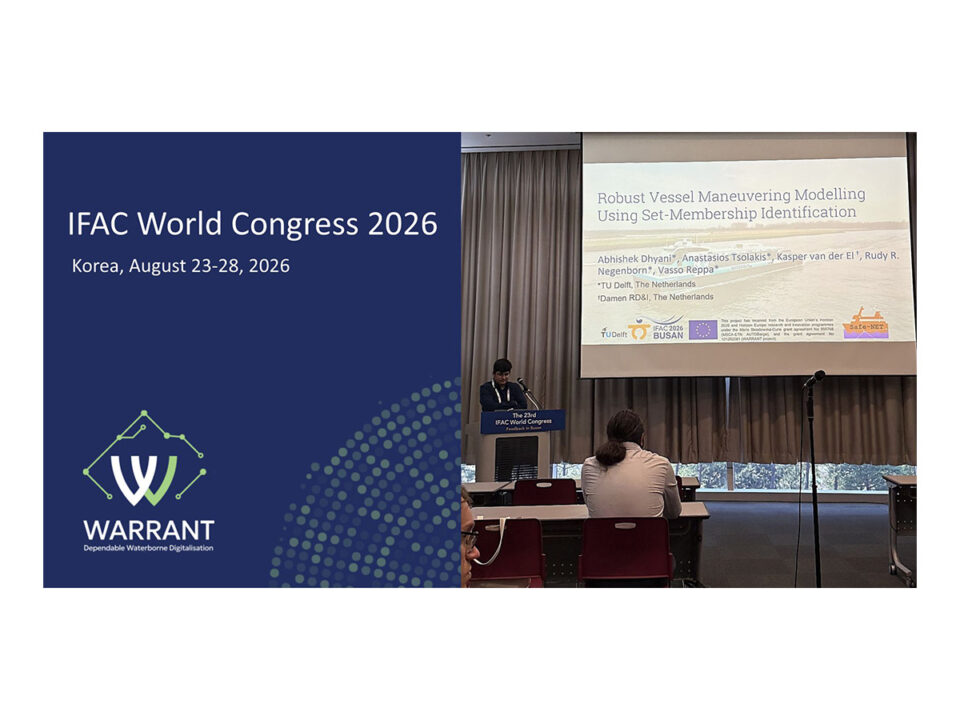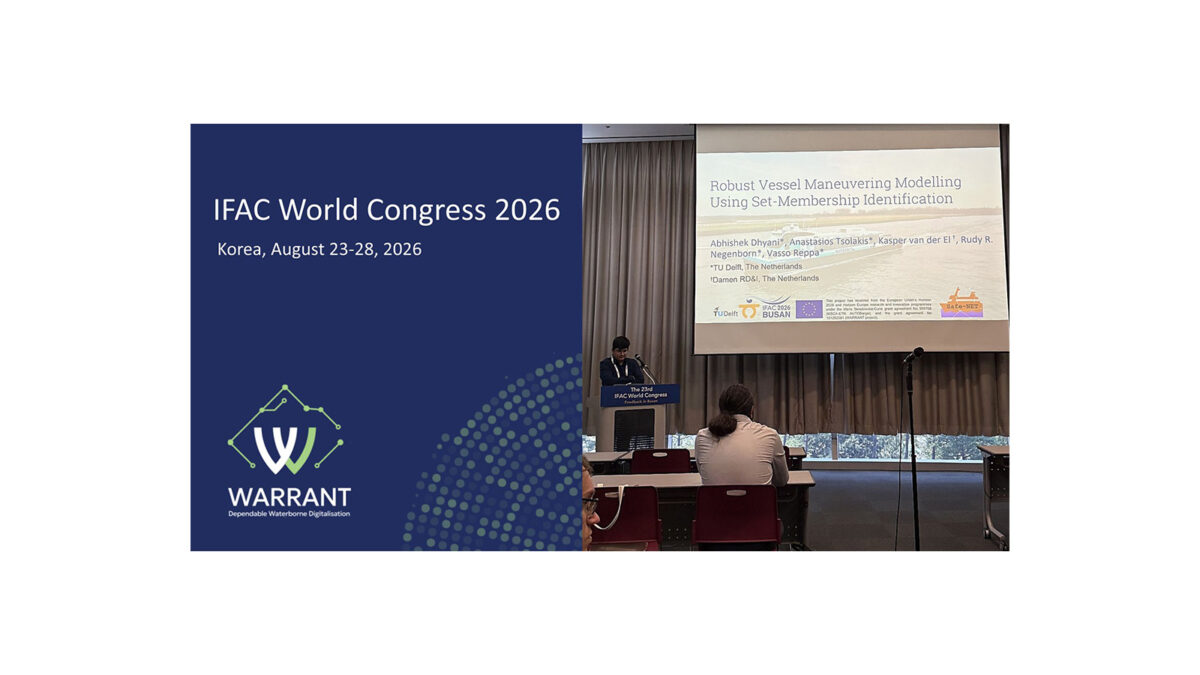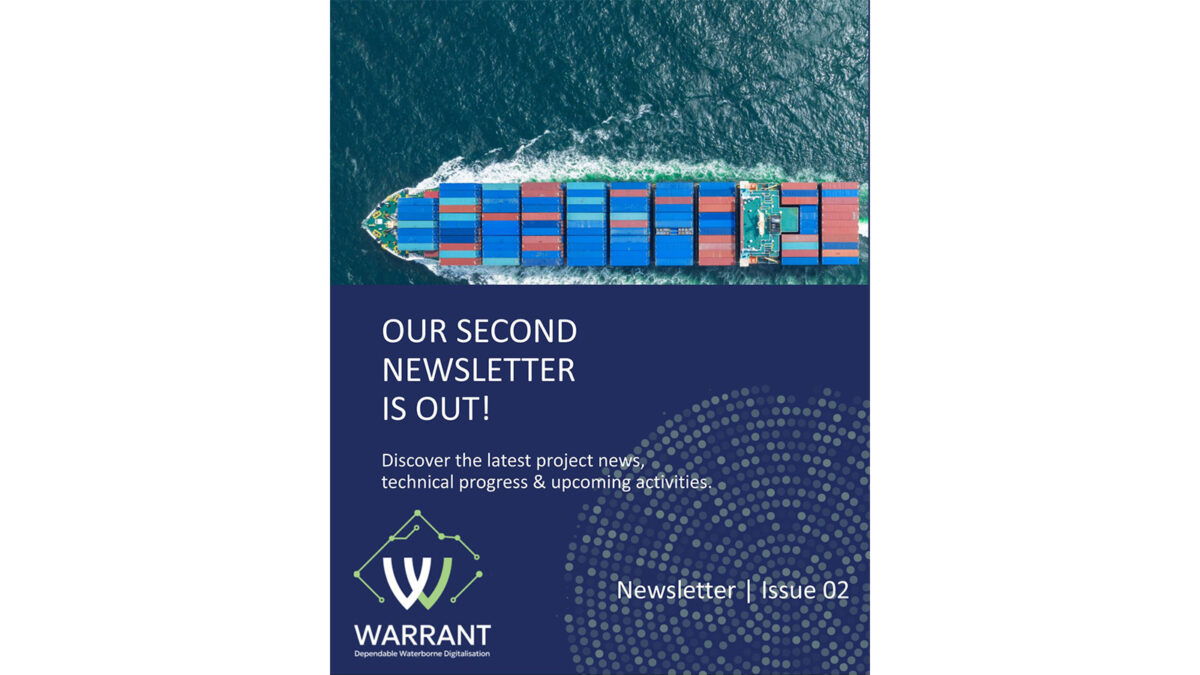


WARRANT Research Presented at the IFAC World Congress 2026
September 1, 2026
WARRANT Featured in Digital Ship’s Maritime Technology Newsletter
October 16, 2026Online, 25 September 2026 – The Horizon Europe-funded WARRANT project held its Living Lab 1 stakeholder workshop, DANAOS Deep-Sea Shipping, bringing together project partners and maritime stakeholders to explore how the safety, cybersecurity and resilience of containership digital systems can be strengthened through the WARRANT Methodology, Knowledge Platform and Digital Twin modelling.
As ships become increasingly connected and automated, growing system complexity and emerging cyber threats make it essential to consider cybersecurity, safety, resilience, human factors and interactions between onboard systems as part of an integrated approach.
The workshop opened with an introduction by INLECOM, outlining the objectives of the session and the role of Living Lab 1 in validating the WARRANT approach for dependable containership digital systems.
Experts from the National Technical University of Athens (NTUA) presented current approaches to maritime risk assessment, including Hazard and Operability Analysis (HAZOP), safety implications and potential hazard-escalation pathways.
DANAOS Shipping, which leads WARRANT Living Lab 1, presented a GPS spoofing scenario examining how manipulated positioning information could affect interconnected navigation systems and potentially contribute to unsafe route deviations, collision risks, grounding or operational disruption. The scenario also highlighted the importance of detecting inconsistencies between data received from GPS, speed-log, gyrocompass, radar and electronic chart systems.
Konnecta Systems (KNT) presented the WARRANT ontology and explained how it supports the structured representation and interconnection of information relating to maritime systems, threats, risks, dependencies and mitigation measures. KNT also introduced the interconnection of the WARRANT framework, including its architecture, the calculation and assessment of key performance indicators and the identification and prioritisation of appropriate mitigation measures. The session considered how the ontology, cross-sensor information and Digital Twin modelling could support dynamic threat identification, dependability assessment, response and operational recovery.
The programme also addressed adversarial attacks targeting computer-vision algorithms used in maritime applications. DANAOS Shipping presented the relevant use case, while TECNALIA explored potential mitigation strategies and their implementation.
All of the aforementioned contributions demonstrated how the WARRANT methodology, Knowledge Platform and Digital Twin capabilities can support an integrated process covering threat identification, anomaly detection, dynamic risk assessment, dependability evaluation, mitigation selection, response and recovery.
Stakeholder involvement in the validation process
Workshop participants were invited to assess the operational relevance of the scenarios and provide feedback on:
- The realism of the use cases and their relevance to maritime operations
- Potentially missing threat vectors and operational dependencies
- Available detection capabilities and incident-response challenges
- Safety consequences and the assessment of cyber-related safety risks
- Resilience measures and additional safety barriers
- The capabilities that the WARRANT platform should provide
- The most meaningful key performance indicators for ship operators
- Decision-support outputs required both onboard and ashore
This stakeholder engagement will contribute to the continuing refinement and validation of the WARRANT approach and help ensure that its methods and resources respond to real operational needs.
About WARRANT
WARRANT is a Horizon Europe research and innovation project developing an integrated approach to the safety, cybersecurity, resilience and dependability of digital waterborne transport systems.
The project’s methodology, Knowledge Platform and Digital Twin resources are being developed and refined through four maritime Living Labs covering containership digital systems, smart container connectivity, autonomous green vessels and remote operations.
The project is also developing reusable knowledge, tools and guidance to support maritime stakeholders in addressing the increasingly interconnected safety and cybersecurity challenges associated with waterborne digitalisation.
More information on the project: https://warrant-project.eu/
Funded by the European Union. Views and opinions expressed are, however, those of the author(s) only and do not necessarily reflect those of the European Union or the European Climate, Infrastructure and Environment Executive Agency (CINEA). Neither the European Union nor CINEA can be held responsible for them.WARRANT has received funding from the European Union’s Horizon Europe research and innovation programme under Grant Agreement No 101202581.